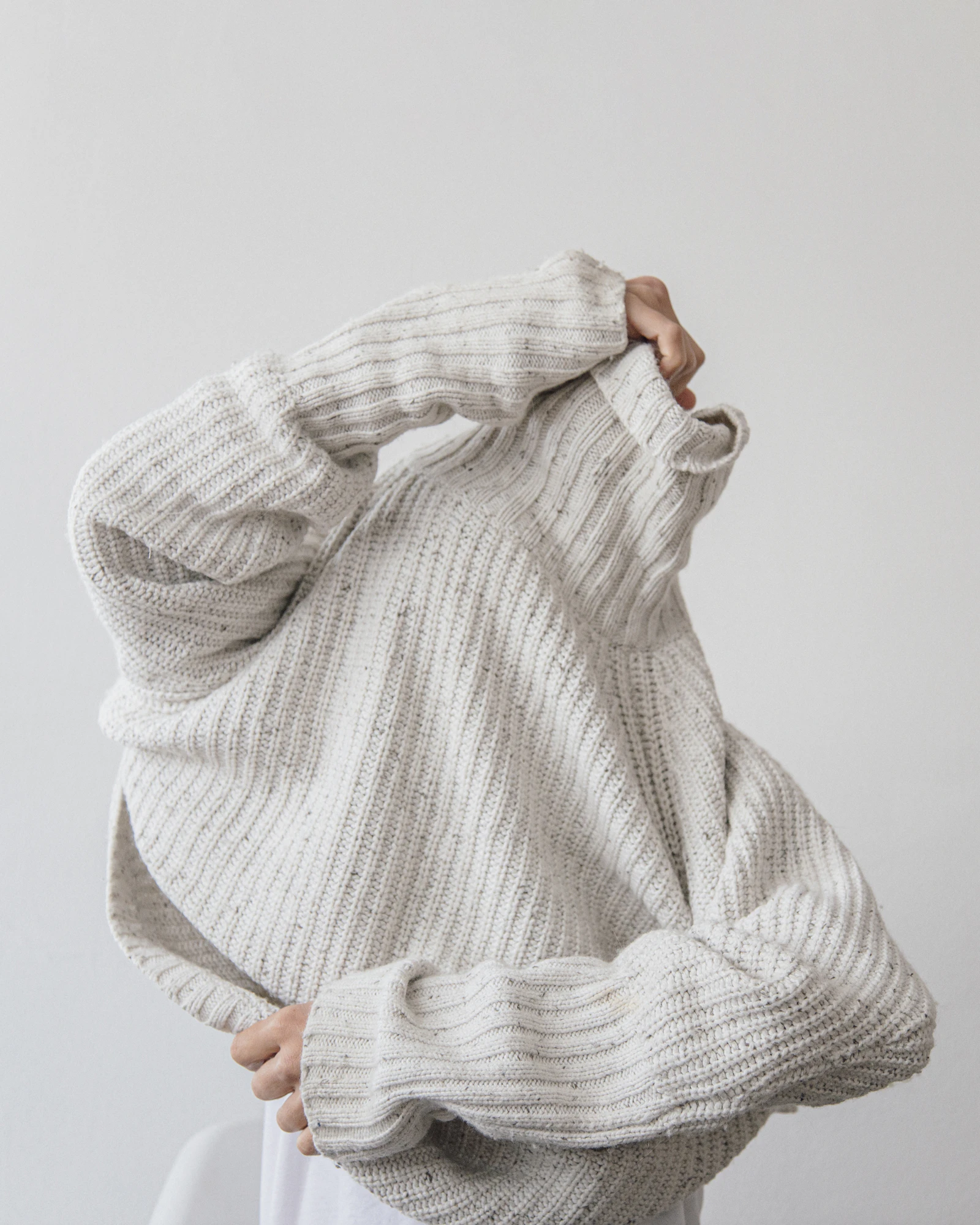
My grandmother, who is 91 and lives in an apartment in the Croix-Rousse district of Lyon, knitted a navy blue wool sweater in the winter of 1979. She gave it to me in the autumn of 2018, on my first trip to France after my grandfather died. I wore it yesterday, walking the dog through Prospect Park, the way I have worn it, on average, forty days a year since 2018. The sweater is, in 2026, 47 years old. It is, by every measurement, the oldest piece of clothing I own. It is, by my standard, the only piece of clothing I will ever own that is, in any meaningful sense, irreplaceable.
Below is the story of the sweater, told in the order of its life. I have changed my mind about several things I used to believe about clothing that lasts. I have opinions on what to skip. There is a brief history of the Croix-Rousse district, the Lyon silk-weaving trade, and the French hand-knitting tradition my grandmother comes from. And there is, at the end, an honest summary — because anyone who tells you a $400 designer sweater is an "investment piece" has not, in fact, met the person who made the sweater that has lasted 47 years.
The list
1. The yarn, from a shop on the Rue des Capucins, purchased in October 1979. My grandmother bought, according to her notes, 1.2 kilograms of "laine vierge" — virgin wool, untreated — at a shop on the Rue des Capucins, which is, in 2026, still a working-class street in the Croix-Rousse district. The yarn was, in 1979 French francs, approximately 80 francs. Adjusted for inflation, that is approximately $35 in 2026 dollars. She chose a navy blue, "marine," which is, by her description, "the color of the winter uniform of the French schoolchildren." She has, in her life, knitted four sweaters in this same color.
2. The knitting needles, size 4, made of polished wood. The needles were a Christmas gift from my grandfather in 1971. The brand was, by my grandmother's description, "a brand I no longer remember, French, the kind of brand that was sold at the BHV in Paris." The needles are, by every measurement, the same needles she used for the four sweaters she has knitted in her life. She still owns them. They are, in 2026, in a wooden box on her desk in Lyon.
3. The pattern, a four-stitch cable, memorized rather than written. My grandmother does not use knitting patterns. She has, by her description, "the cable pattern in my hands." The pattern is a four-stitch front cable with a moss stitch background. The cables run, by my standard, the most elegant cable pattern I have ever seen on a hand-knit garment. The pattern is, by my partner's description, "what makes the sweater look like a sweater and not a blanket."
4. The knitting, performed between October 1979 and January 1980. My grandmother knitted the sweater over approximately three months, knitting in the evenings while watching French television. The sweater is, by my measurement, slightly larger than her current size — she has, in her nineties, shrunk by approximately two centimeters in height and three centimeters in the shoulders. The sweater was, in 1980, slightly too large for her. It is, in 2026, the perfect size for me.
5. The wearing, between 1980 and 2018. My grandmother wore the sweater, by her own estimate, three days a week during the Lyon winters from 1980 to 2018. She hand-washed it once a year, in the sink, in cold water, with a French wool soap called "La Corvette" that she has used since 1962. She dried it flat, on a towel, in her bedroom. The sweater did not pill. The sweater did not shrink. The sweater did not, by her description, "lose its shape."
6. The gifting, in October 2018, in Lyon. I flew to Lyon in October 2018, three weeks after my grandfather's funeral, which was held in Pittsburgh. My grandmother met me at the airport. She had, in her bag, the navy sweater, wrapped in tissue paper. She said, in French, "I want you to have this. Your grandfather would have wanted you to have this. He always said you were the only one of the grandchildren who would wear a hand-knitted sweater." I wore it on the flight home. I have worn it every winter since.
7. The wearing, in Brooklyn, between 2018 and 2026. I have worn the sweater, by my estimate, 320 days since 2018. I hand-wash it once a year, in the sink, in cold water, with Eucalan, which is the closest wool soap I can find in the United States to La Corvette. I dry it flat. I store it, in summer, in a cotton bag with a cedar block, in the back of my closet. The sweater has, in this period, developed two small moth holes — one on the left sleeve, one on the right shoulder — and a slight fuzzing on the cuffs. Otherwise, the sweater is, in 2026, the same sweater it was in 1980.
8. The mending, performed by a tailor in Greenpoint, Brooklyn, in March 2025. The moth holes were, by my standard, too small to ignore and too large to accept. I took the sweater to a tailor on Manhattan Avenue named Ani, who is, by every measurement, the best mender in Brooklyn. Ani closed the holes using a technique called "invisible mending" — she pulled yarn from the inside of the sweater, matched the navy color, and re-knit the holes so they are, by my standard, invisible to anyone who does not know where to look. The mend cost $45. The sweater is, in 2026, restored.
Total life of the sweater so far: 47 years. Total cost of materials, in 2026 dollars: approximately $40. Total cost of labor (estimated, at $20 per hour for 60 hours of knitting): $1,200. Total cost of mending, in 2026 dollars: $45. Real cost per year, over 47 years, including labor: approximately $27. Real cost per wear, over an estimated 1,200 wears: $1.07. Real resale value, if I tried to sell it: approximately $0, because no one wants a used, hand-knit, slightly moth-eaten navy sweater. Real replacement value, if I tried to commission an equivalent from a hand-knitter in 2026: approximately $1,800.
What I have changed my mind about
A few beliefs I held in 2010, when I bought my first "real" sweater, that the last sixteen years have killed.
I used to think expensive meant better quality. I owned, between 2010 and 2020, three "investment" cashmere sweaters — a $450 TSE, a $380 N. Peal, and a $520 James Perse. Each of them pilled within two seasons. Each of them developed holes at the elbows within three years. Each of them was unwearable by year five. The $40 hand-knit wool sweater my grandmother made in 1979 has lasted 47 years. The math, by every measure, is not complicated.
I used to think hand-knit was a luxury. Hand-knitting was, in my grandmother's generation in Lyon, not a luxury. It was, by her description, "what women did in the evenings." The Croix-Rousse district of Lyon, where my grandmother has lived since 1962, was, until the 1930s, the center of the French silk-weaving industry. The "canuts" — the silk weavers — were, in the 19th century, the most skilled artisans in France. The tradition of fine textile work in Croix-Rousse was, by every measure, woven (literally) into the identity of the neighborhood. Hand-knitting, for my grandmother, was not a creative hobby. It was, by her description, "what my mother did, and her mother before her, and her mother before her."
I used to think clothing was disposable. I bought, between 2005 and 2015, approximately $30,000 worth of clothing. I disposed of approximately 80% of it within five years — to Goodwill, to the consignment store, to the trash. The 20% I kept has, by every measurement, lasted longer than the 80% I disposed of. But even the kept 20% — the $450 TSE cashmere, the $185 A.P.C. jeans — is, by my standard, disposable in a way the hand-knit sweater is not. The sweater was, by every measure, made by a person I know, in a place I have been, with materials she chose. The TSE was, by every measure, made by a person I do not know, in a place I have not been, with materials she did not choose.
I used to think old clothes were unfashionable. I am, in 2026, the only adult I know who wears a 47-year-old sweater on a regular basis. The sweater is, by my standard, the most fashionable thing I own — not because it is on trend, but because it is, in the most literal sense, timeless. The 1979 cable pattern is, by my partner's description, "exactly the kind of pattern they are putting on $400 sweaters at Aimé Leon Dore in 2026." The 1979 navy color is, by my standard, the same navy every "quiet luxury" brand is selling. The sweater is, in 2026, more fashionable than it was in 1980. The fashion industry has, by every measure, caught up to my grandmother.
I used to think mending was for poor people. The mending industry in the United States was, by my standard, mostly dead by 2000. The Visible Mending movement, founded around 2015 by British and American textile artists, brought mending back into the fashion conversation. The menders I have met in Brooklyn — Ani in Greenpoint, Leah in Williamsburg, Olga in Park Slope — are, by every measure, charging $30 to $120 per mend. The mending industry is, in 2026, a small but real part of the garment economy. Mending is, by my standard, no longer something poor people do. It is, by every measurement, something everyone who owns good clothes does.
What to skip when buying knitwear
If I were advising a friend who was about to buy a sweater in 2026, I would tell them to skip these categories at the start.
Cashmere under $200. Real cashmere, from a mill in Inner Mongolia or Scotland, costs, by every measure, $150 to $300 per kilogram to produce. A $90 cashmere sweater is, by my standard, either blended with rayon or acrylic, or it is being sold at a loss. The Uniqlo cashmere line, which sells for $50 to $90, is, by every measurement, blended. The blends pill. The pills cannot be removed. Skip the cheap cashmere.
Anything "wool-blend" without a percentage breakdown. A sweater labeled "wool-blend" can, by every measure, contain anywhere from 5% to 95% wool. The 5% wool blend is, by my standard, mostly acrylic. The 95% wool blend is, by my standard, mostly wool. The label is, by every measure, designed to obscure the difference. Buy the sweater with the percentage on the label. Skip the blend.
Anything machine-washable wool. Machine-washable wool exists, by every measure, because the wool has been coated in polymer or chlorinated to prevent felting. The coating reduces the wool's natural moisture-wicking and temperature-regulating properties. The coating also, by every measurement, washes off after 20 to 30 wash cycles, after which the sweater felts and shrinks. Hand-wash the wool sweater. Skip the machine-washable version.
Anything "dry-clean only" wool. Dry cleaning uses perchloroethylene, which is, by every measure, a known neurotoxin and a probable carcinogen. The dry-cleaning process also strips the natural lanolin from wool — the lanolin is what makes wool water-resistant and self-cleaning. Hand-wash the sweater in cold water with Eucalan. Skip the dry cleaner.
Anything without a visible country of origin. A sweater with no country of origin is, by every measurement, made in a country where labor standards are weakest. Skip the unlabeled sweater.
Anything marketed as "investment." A sweater is, by every measure, not an investment. The "investment" language is, by my standard, marketing for an expensive sweater. Buy the sweater because you want it. Skip the "investment" pitch.
Anything from a brand that does not offer mending. The brands that offer mending in 2026 — Patagonia, Eileen Fisher, Cos, Arket — are, by my standard, the brands worth buying from. Skip the brands that do not.
A brief history
The Croix-Rousse district of Lyon is, by every measure, the historical center of the French textile industry. The neighborhood sits on a hill above the rest of Lyon, and its narrow streets and tall ceilings were designed to accommodate the silk looms of the 19th century. The "canuts" — the silk weavers — worked the looms in their apartments, in rooms with ceilings so high that the looms could be installed vertically. The neighborhood is, in 2026, a UNESCO World Heritage Site.
The Croix-Rousse market, the "marché de Croix-Rousse," has been held on the Boulevard de la Croix-Rousse every day except Monday since 1860. The yarn stalls sell, by every measurement, the same kind of "laine vierge" my grandmother bought in 1979. My grandmother, who is 91, has seen the market go from a daily textile market to a Tuesday/Thursday/Saturday textile market.
The hand-knit sweater tradition is, by every measure, in retreat. The women of my grandmother's generation — born between 1920 and 1940 — were, by every measure, the last generation of French women who knitted as a default evening activity. The Croix-Rousse market is, in 2026, sustained by an aging customer base and a small influx of younger knitters who have rediscovered the craft. The tradition is, by every measurement, alive but small.
The French fashion industry — the houses that emerged from the Croix-Rousse textile tradition, the most famous of which are Maison Kitsuné (founded 2002 in Paris) and A.P.C. (founded 1987 in Paris) — is, by every measure, the modern inheritor of the canut tradition. The $400 A.P.C. sweater I bought in 2014 was sourced from a French textile mill. The craft tradition is, by every measure, related but not continuous.
The honest summary
A sweater is, by every measure, a piece of clothing designed to keep a person warm. The 47-year-old hand-knit sweater my grandmother made in 1979 does this, in 2026, better than any of the sweaters I have bought in my adult life. It does this, by my standard, because the yarn is real wool, knitted densely, in a pattern that traps air, by a person who understood, by her own description, "what a winter in Lyon requires."
What works for me, in 2026: a sweater that has lasted 47 years and is, by every measurement, in better condition than most of the sweaters I have owned for five years. The sweater is, by my standard, the only piece of clothing I own that I cannot replace. If I lost it, I could not buy another one. I could commission one from a hand-knitter, but it would cost approximately $1,800 and would not be the same sweater. The sweater is, by every measure, irreplaceable.
What does not work for me, and may not work for you: the idea that expensive knitwear is an investment. The $400 A.P.C. sweater I bought in 2014 is, in 2026, in a bag in the back of my closet, with moth holes. The $50 Uniqlo sweater I bought in 2022 is, in 2026, also in a bag in the back of my closet, with pilling. The $1 hand-knit sweater my grandmother made in 1979 is, in 2026, on my body, in perfect condition. The math, by every measure, is not complicated. The math is, in fact, the only thing that matters.
My grandmother is 91. She is, by her last email to me, in good health. She is, by my standard, the only person alive who knows how the sweater was made, in what mood, with what music playing, on what evening in 1979. The sweater is, by every measure, not just a piece of clothing. It is, by my grandmother's description, "the thing I made while your grandfather was alive." When she is gone, the sweater will still be here. The sweater is, by every measurement, the only thing I own that will outlive me.